How to Choose a Political Campaign Website Builder
A political campaign website builder can get a candidate online quickly and affordably. But choosing one based only on templates or monthly price misses the larger issue.
A campaign website has a job to do. It needs to introduce the candidate, explain the race, collect supporter information, promote events, direct visitors to donations, publish updates, and change emphasis as Election Day approaches.
You can do all of that with a general-purpose website builder. The difference is how much you have to figure out and assemble yourself.
Online Candidate has built political campaign websites since 2003. Over the years, we’ve seen candidates use custom developers, volunteers, general website builders, political platforms, and just about every combination in between.
Based on that experience, these are the things we think matter most.
Start With the Campaign, Not the Website Builder
Most website builders can create pages, display photos, add navigation, and publish forms. Those are basic website functions.
A political campaign usually needs a more specific structure:
- Candidate biography
- Issues or priorities
- Donations
- Volunteer recruitment
- Endorsements
- Campaign news
- Events
- Contact information
- Voting and election information
- Clear calls to action
For an experienced web developer, creating those pieces is straightforward. For a first-time candidate trying to launch quickly, deciding what the website needs can take longer than actually building it.
That’s one advantage of a political-specific website builder: you’re not beginning with a blank business template and trying to turn it into a campaign site.
The basic structure should already make sense for someone running for office.
Experience With Your Type of Race Matters
This is something candidates don’t always consider until there’s a problem.
Building a website for a political campaign is not quite the same as building one for a restaurant, law firm, or local contractor. Even within politics, a sheriff campaign is different from a school board race, a judicial campaign, or a run for state legislature.
The website structure, emphasis, and sometimes even the rules can be different.
For example, a sheriff candidate may need to put professional qualifications and law-enforcement experience front and center. A school board candidate may need more emphasis on district-specific priorities and community involvement. Judicial campaigns can face additional restrictions on what candidates may say or how they present themselves, depending on the jurisdiction.
Then there are the less obvious problems.
Campaign disclaimer requirements vary by state and locality. Some jurisdictions restrict the use of official seals, insignia, or other government imagery in campaign materials. Law-enforcement candidates may face rules about photographs in uniform. Even seemingly harmless wording can create problems if it implies that a challenger already holds the office.
A website company doesn’t need to act as your election attorney, and candidates should always confirm legal requirements with the appropriate election authority or counsel. But there is value in working with people who have built websites for the type of office you’re seeking and have seen the issues that can trip candidates up.
Experience helps with smaller decisions, too: what pages usually matter, what information voters look for, where calls to action belong, and what campaigns often forget to provide before launch.
A good campaign website builder should give you more than software. It should reflect an understanding of how campaign websites are actually used.
Make Sure the Site Can Change as the Race Changes
A campaign website built six months before Election Day shouldn’t look exactly the same six days before Election Day.
Early on, the emphasis may be biography, issues, and introducing the candidate. As the campaign develops, endorsements, news, volunteer recruitment, fundraising, and events become more important.
Later, the homepage may need to shift toward early voting, absentee information, Election Day reminders, or a final fundraising push.
That means campaign staff should be able to make routine changes without waiting for a developer.
Useful capabilities include:
- Adding and editing pages
- Posting campaign news
- Publishing events
- Changing navigation
- Highlighting announcements
- Updating calls to action
- Creating landing pages
- Promoting time-sensitive information
We’ve seen campaigns get frustrated when a simple website change requires submitting a request and waiting for someone else to make it. In politics, two business days can be a long time.
The candidate or a trusted campaign staff member should be able to handle routine updates directly.
Pay Attention to What Happens After Someone Fills Out a Form
Nearly every website builder can create a contact form.
The better question is: What happens to the information afterward?
Campaign websites may collect:
- Contact requests
- Volunteer signups
- Email subscriptions
- Endorsements
- Yard sign requests
- Other supporter responses
If those submissions exist only as individual emails, they become surprisingly easy to lose.
Find out whether the website keeps a record of submissions and whether campaign staff can review them later.
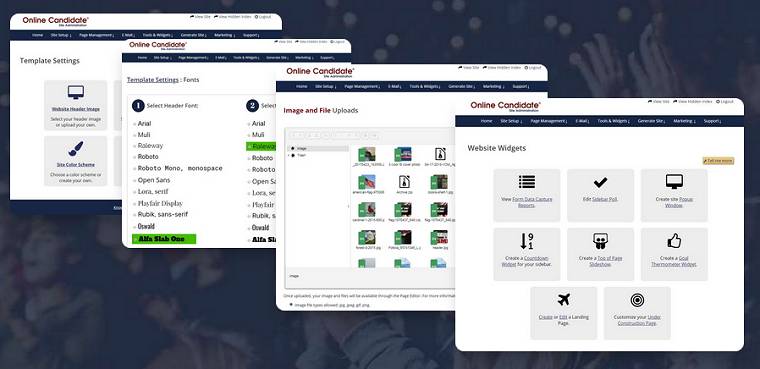
Online Candidate, for example, stores website form submissions in the administration area. Campaign staff can review contact, volunteer, endorsement, donation-related, and email signup activity rather than depending entirely on the original email notification.
That does not make the website a full voter database or campaign CRM. It isn’t intended to.
For many smaller campaigns, however, having an accessible record of activity generated through the website is useful. Larger campaigns with more extensive voter-contact and organizing needs may want a dedicated CRM or campaign-management platform alongside the website.
Know which level you actually need.
Your Donation Platform Should Be Your Choice
We generally prefer integrating an established political fundraising service rather than having the website itself act as the campaign’s payment processor.
Services such as ActBlue, WinRed, Anedot, and other fundraising platforms are built around political contributions and their associated requirements.
Your website builder should make it easy to use whichever fundraising provider fits your campaign.
It should also let you promote donations throughout the site. A donation link doesn’t belong only on a Donate page.
Campaigns may want donation calls to action in:
- The website header
- Campaign news
- Fundraising announcements
- Events
- Homepage promotions
- Landing pages
- Popups or announcement bars
When fundraising matters, supporters shouldn’t have to hunt for the contribution link.
Decide How Much Website Work You Really Want to Do
DIY website builders are inexpensive partly because you provide the labor.
Someone still has to choose the design, add the campaign branding, organize pages, upload photographs, enter the copy, configure forms, add donation links, proofread everything, and make sure the site looks right before launch.
For some campaigns, that’s no problem. They have someone comfortable doing it and would rather keep the cost down.
For others, saving money on setup isn’t much of a bargain if the candidate spends a weekend fighting with a website instead of fundraising or campaigning.
This is why we don’t think the decision is always simply:
DIY website vs. professionally designed website.
A better question is:
How much help does the campaign need getting started?
With Online Candidate, candidates can build their own political campaign website, add professional design or content setup, or have the initial website prepared for them. The underlying platform is the same.
That also leaves room for plans to change. A campaign that starts DIY may decide it needs help later without having to move to another website system and start over.
Don’t Let a Cheap Website Cost You Control
Domain ownership is one of the least interesting parts of building a campaign website — until something goes wrong.
We’ve seen candidates lose access to domains because a volunteer, consultant, or web designer registered the name under their own account.
Before launching, know:
- Who registered the domain
- Who controls the registrar account
- Whether the campaign can change its DNS settings
- Whether the domain can be transferred
- What happens to it after the election
The same principle applies to other campaign accounts. Important digital assets should remain under campaign control rather than being tied exclusively to one volunteer or vendor.
This matters beyond the current election. Candidates often run again.
A domain that seemed temporary during a first campaign can become valuable several years later.
Check the Boring Technical Details
Templates get most of the attention when people shop for website builders. Some less exciting features matter more over the life of the site.
Confirm that the service includes or supports:
- Secure HTTPS hosting
- Mobile-friendly design
- Backups and reliable hosting
- Page titles and meta descriptions
- Social sharing controls
- Analytics or analytics integration
- Search engine verification
- Campaign email addresses or an easy way to use outside email
- Multiple administrative users, if needed
For search visibility, the basics matter most. The site should clearly identify the candidate’s full name, office sought, location or district, and election information.
You don’t need an elaborate SEO system to accomplish that. You do need control over the basic information search engines and voters use to understand the site.
Find Out What Support Really Means
Almost every software service claims to offer support.
Find out what that means before you need it.
Can you email someone? Submit a support request? Call? Is there useful documentation? Does support understand political campaigns or only the software itself?
This becomes more important as Election Day gets closer.
A candidate trying to update voting information, fix a form, or change an urgent homepage message doesn’t care that the software is normally easy to use. They care about getting the problem resolved.
One advantage of working with a company focused on campaigns is that the support staff should understand why the change matters and why timing can be important.
What About Wix, Squarespace, WordPress, and Other General Website Platforms?
They can all be used to create political campaign websites.
If you already know one of those systems, have an experienced developer, or need something a specialized campaign platform cannot provide, a general website platform may be the right choice.
The tradeoff isn’t necessarily quality. It’s how much campaign-specific work you need to do yourself.
A general platform doesn’t automatically know that you need an Issues section, volunteer signup, donation integration, endorsement area, campaign disclaimer, election information, or an Election Day call to action.
You choose the pieces, decide how they fit together, and configure them.
For someone who knows websites, that’s manageable.
For a candidate whose goal is simply to get a credible campaign website online and move on to campaigning, a political-specific platform can remove a lot of unnecessary decision-making.
Questions to Ask Before Choosing a Campaign Website Builder
Before committing to a service, get answers to the questions that will affect your campaign:
- Is the platform designed specifically for political campaigns?
- Has the provider built websites for candidates running for my type of office?
- What campaign-specific pages and tools are included?
- Can campaign staff update the site without coding?
- How are volunteer, contact, and other form submissions stored?
- Can I use my preferred political fundraising service?
- Can the site match our campaign branding?
- Who controls the domain name?
- Are secure hosting and SSL included?
- Can multiple campaign staff members have access?
- What SEO, analytics, and social-sharing controls are available?
- What support is available when something goes wrong?
- Can I get professional design or setup assistance if I need it later?
- What happens to the website and domain after the election?
- Are there setup charges, contracts, or other fees beyond the advertised price?
The cheapest platform isn’t automatically the best value. Neither is the one with the longest feature list.
The right choice is the one that fits the campaign’s resources, technical ability, timeline, and actual needs.
Online Candidate’s Political Campaign Website Builder
Online Candidate has specialized in campaign websites since 2004. Over that time, we’ve worked with candidates running for municipal, county, school board, judicial, law-enforcement, state, and federal offices.
That experience has shaped the platform as much as the software itself.
In 2026, we introduced an updated campaign website platform with improved editing, expanded event management, additional campaign engagement tools, and more ways to promote donations and important campaign information.
The platform includes campaign-specific pages, contact and volunteer forms, endorsement management, stored submission records, news and events, donation integrations, landing pages, election countdowns, announcement bars, popover messages, website analytics, SEO controls, and other tools designed around candidate websites.
You can review the campaign website features for a more detailed list.
Candidates who want to handle the setup themselves can use our Political Campaign Website Builder for $29 per month with no long-term contract.
Candidates who would rather not build the initial site themselves can choose professional design or content setup instead. All campaign website packages use the same platform.
We’ve never believed every campaign needs the most complicated website possible. Most don’t.
What a campaign needs is a site appropriate for the race, a system it can keep current, and reliable help when something unfamiliar comes up.

Additional Resources:
- Download: Political Website Domains and Hosting – What You Need To Know
- Download: Online Candidate Quickstart Guide
Read More:


Getting Your Campaign Website To Rank On Search Engines »
Tags: hosting